

plants as subjects, plants as informants
In Conversation with Myriam Gurba
Part II
Billy Lezra
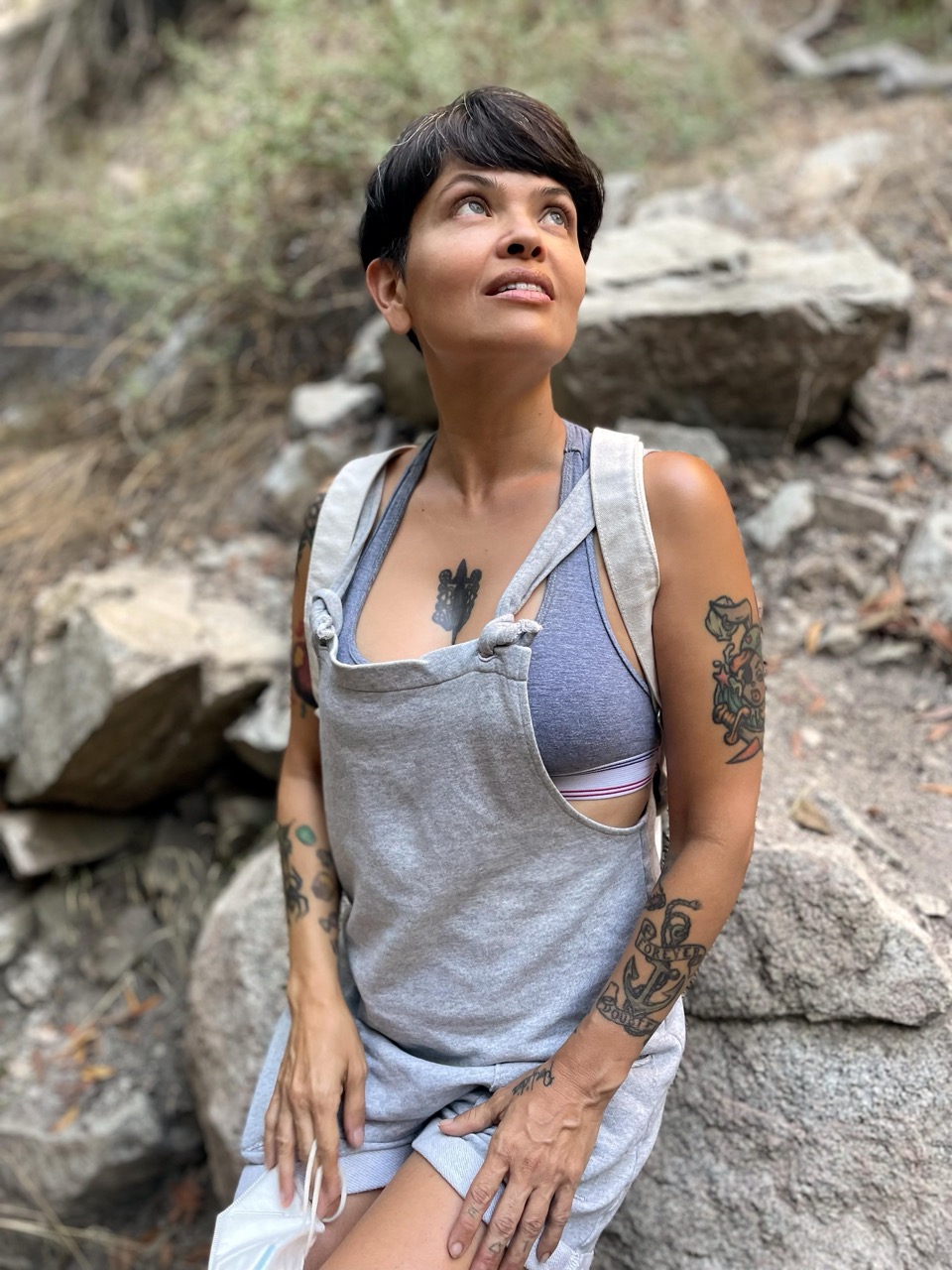
photo by Geoff Cordner
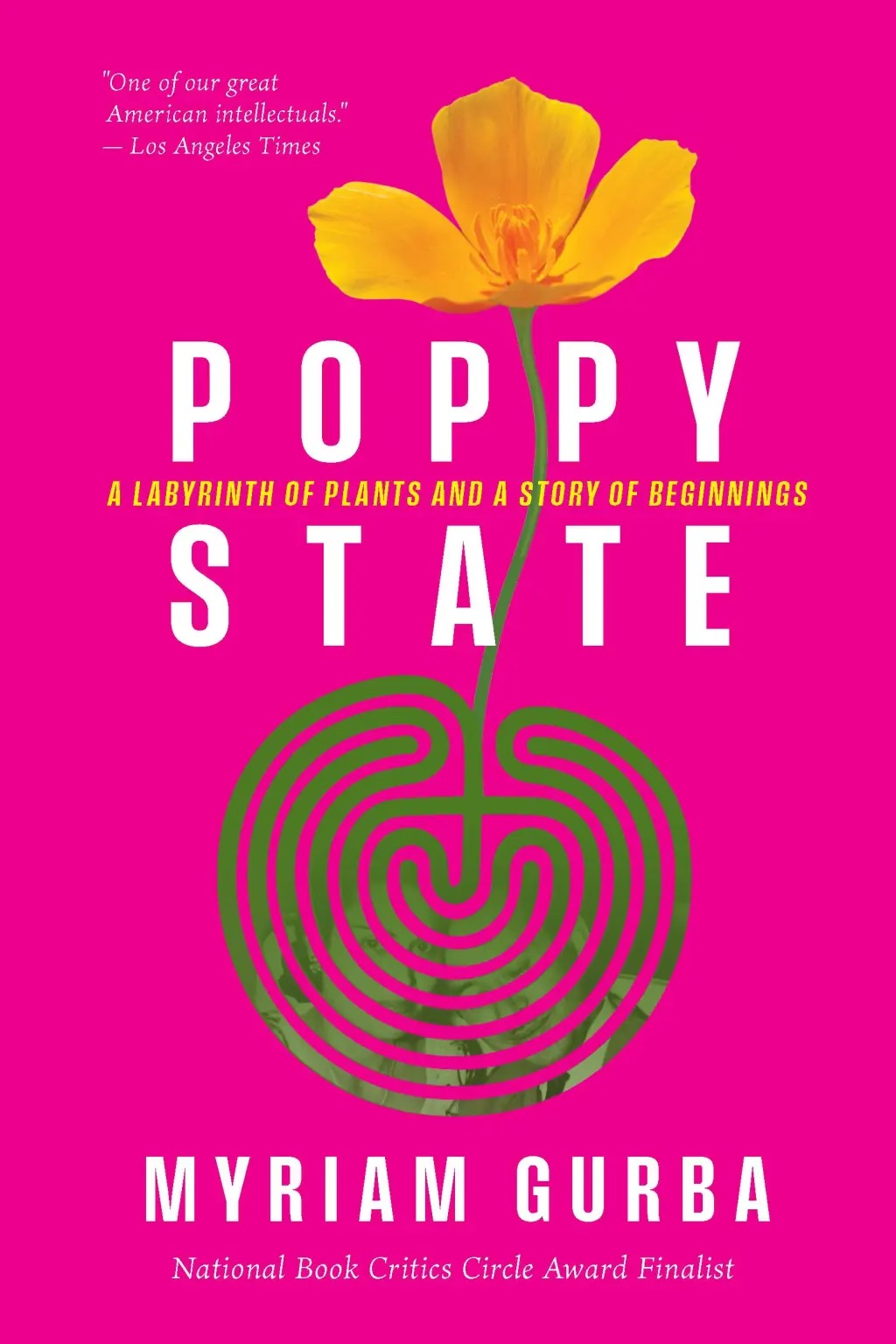
Myriam Gurba is a writer and activist. Her first book, the short story collection Dahlia Season, won the Edmund White Award for Debut Fiction. O, the Oprah Magazine ranked her true-crime memoir Mean as one of the “Best LGBTQ Books of All Time.” Her recent essay collection “Creep: Accusations and Confessions” was a finalist for a National Book Critics Circle award for Criticism, and won the Lambda Literary Award for Bisexual Nonfiction. She has written for the New York Times, Los Angeles Times, Harper’s Bazaar, Vox, and Paris Review. Her new book, “Poppy State: A Labyrinth of Plants and a Story of Beginnings,” was published by Timber Press in October 2025.
In Poppy State, California plants serve as structural anchors in a wildly inventive work of narrative nonfiction that is part botanical criticism, part personal storytelling, and part study of place. The reader is invited to commune with California with Gurba as their guide, ushered through a compendium of anecdotes, reminiscences, utterances, lists, incantations, newspaper articles, and other ephemera.
This interview has been edited for clarity and length.
My first question for you is from your author’s note: do you like surprises, or are you a person who prefers to consult a map prior to a quest?
Both. Sometimes I like to be surprised, but I have to be in a very stable place in my life in order to court surprises. And then, depending on the quest, sometimes I prefer a map. Sometimes I’m very adventurous, and other times, I’m not adventurous at all.
A map can be surprising, too.
A map can be surprising, and a map can be misleading. Sometimes you’re given a map, but the map doesn’t align with what it claims to represent.
The reason I wanted to start with that question is because I am hoping our interview will mirror the labyrinthian structure of Poppy State. I’ve prepared my questions and written them down on these pink and blue and yellow cards. Before every question I am going to shuffle the cards, so neither of us will know where we are going next. This is a contained surprise, so to speak.
This is fun for me. I do think that a maze and a labyrinth are containers. And they are containers that prompt surprise.
(Shuffles.)
There are so many titillating moments of wordplay in Poppy State: hoja, hoja, hojalá, ojalá. How do these moments come to you?
Those moments come to me through play. When I write, I’m playing. I’m having fun, and language becomes a toy. I let language show me the various faces that may have been hidden from me. So for example, if I’m going to write about horticulture or botany, I’m going to write about plants, and I’m doing so in a way that invites Spanglish thought. I’m going to think about leaf, and I’m going to think about hoja. And when I start repeating the word hoja, mentally, almost as a mantra, that’s going to invite related words. Sometimes the words are related botanically, but sometimes the words are simply related through sound, like ojalá. And so suddenly you get hoja, hoja, hojalá, ojalá. I find it delicious. It’s like eating candy. The language is a sugary toy. You’re getting these dopamine hits from the experience it’s giving.
This reminds me of the way you speak about texture of language. How do you know when an essay wants to be an essay in sentences? In particular, I’m thinking about “Lemmons” and “The Hill Monster.”
That is often intuitive. When writing about my father, I had very specific stories I wanted to share. Doing so was best achieved through a more traditional linear narrative, whereas when I’m writing about the more than human, and in particular, when I’m writing about plants or nonhuman animals, I approach that prose more like water; I let the water do what the water wants.

As I was reading–in particular, I’m thinking about “The Hill Monster”–each sentence seemed to flow into the next with a recurring image or motif. It felt very much like a stream.
I love that. I do consciously try to have these connective motifs that serve as binding agents and form these networks so that ideas that might seem disparate are connected to one another. A very careful reader can start to deconstruct those in the same way that a very careful naturalist might be able to start deconstructing a root network, and see how plants are generating through underground systems of rhizomes. So these two plants that might not seem to have a relationship to one another might actually be the same plant.
Connected through a thin root.
Exactly.
What are the most important elements of your creative ecosystem?
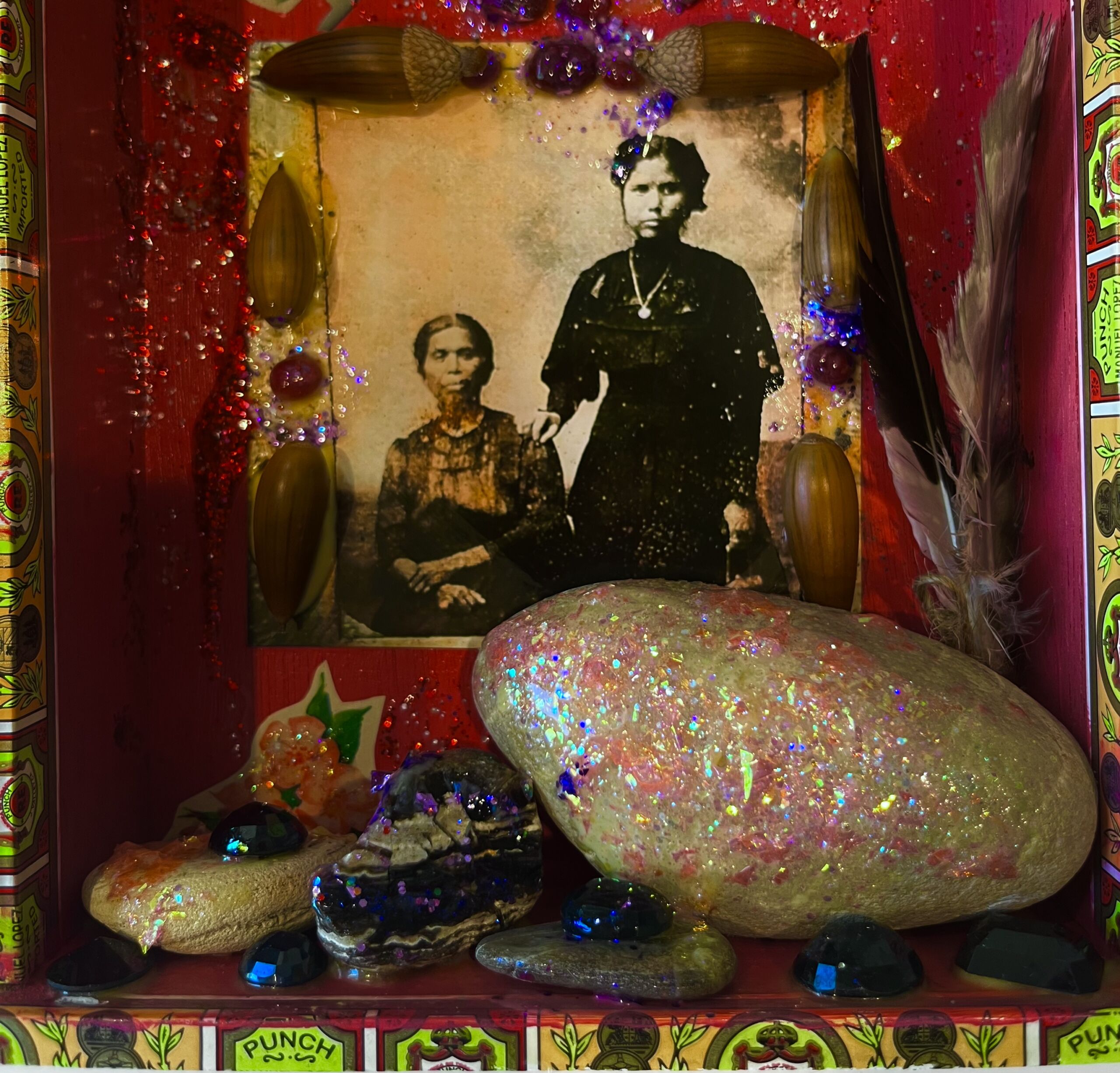
That’s a really amazing and surprising question. I really like thinking of creativity as belonging to an ecosystem. The first element that comes to mind for me is water. I engage in various spiritual practices that require daily practice. So there are daily behaviors that I engage in in my home at three different altars or three different shrines. And one of the most important aspects of caring for those shrines is ensuring that each one has a glass of water present to nourish the spirits that reside at those shrines, because the spirits are living entities, and all entities need water. Water is the source of life for everyone. And so water comes to mind. And then water is critical for me in the sense that when I first wake in the morning–and morning is my most productive and my most creative time–what I first need to do is drink coffee. And I can’t do that without boiling water. So without caffeine, which is a plant-based medicine activated by water, I’m nothing. I would say that half of my creativity is owed to that plant, and half of my personality is coffee-based.
(Laughs.)
I would also say that another element of that creative ecosystem is movement. I’m aware that I write with my entire body from head to toe. Writing isn’t something that’s confined to my hands. A lot of my writing, especially the part of my writing that is problem-solving, happens when I’m walking. Sometimes I go for as many as three or four walks in a day. I tend to walk between three and four miles, and during that process, I’m writing, solving problems. Then I’m able to come to the page and apply what I’ve learned through walking. That’s really critical. I would also say that visiting the plants that grow in my home garden is critical to my process. Because when I go and care for them and observe them, they always serve as mirrors that reflect me back at myself. They do that for me when it comes to all aspects of my life. If I bring myself as a writer to them, they reflect that back to me. In turn, they help enhance and deepen my creativity. For example, if I notice that a plant is experiencing a certain problem, and I have to help that plant overcome that problem, often there’s a lesson that I can apply to my own writing that the plant is imparting to me.
Would you give me an example of a lesson a plant has imparted?
This morning, I went to check on some of the plants I have growing in the vegetable garden in my front yard. I have a pepper bush, poblanos. There was one pepper that was very ready to be harvested. But the others were still in the process of ripening. I picked that one, brought it inside, and added it to a small bowl with other peppers. I now have four peppers that are ripe and ready to be turned into something edible. Those four peppers remind me that I have a set of essays that I haven’t touched in a few months, but they’re ready to be touched now. They’ve been sitting and ripening, and now they’re ready for me to return to them. So there will be these uncanny parallels that the plants will provoke and that will then set me on a path toward some creative act. But the plants have a hand in that.

Who is a tree you currently have a crush on?
I love that question. My heart very much belongs to oaks. I’ve never really been able to move past the girlish crush that I developed on oak trees. This morning I was going for a walk, and I was so happy because it’s been raining cats and dogs here in Southern California. And the land smelled so delicious. Rain gave us this wet potpourri, so I was just ravenously inhaling the aroma from the earth. And I typically walk on one particular side of a street, but I decided to switch it up and walk on this other side, and from this other side, I noticed this oak tree that I had not noticed before. I was like, “That oak looks good!” I was like, “I’ve never seen her from this angle. Oh, my goodness, look at the way that she’s arching her back and throwing out her arms, and her hair looks good.” She knows she’s fabulous. I’m so happy I’ll get to go back and check her out from another angle.
And you hadn’t seen her before!
No, I hadn’t noticed her before. She’s been there, but because of the way that I would walk, I could only see up to her shins because she’s so tall. But now that I saw her from a distance, I got to see her whole body.
Would you speak about the relationship between the fog in Creep and the maze and labyrinth in Poppy State?
I’m so glad that you saw that connection. As I was working on Poppy State, I was very aware that I had relied on this climatological metaphor to indicate soft lethality. Fog is a place where a victim can become lost and missing and never recovered. And so Poppy State for me is a way of exiting that fog. It provides a bridge for exiting it, but that bridge is still fraught because one has to travel through a structure that can be quite confusing. So in a way, there is an extension of that fog, but there’s the suggestion of an exit from it. The other function that’s being performed by both the labyrinth and the fog is that they serve as containers for these monstrous figures that dwell in both. In the case of the fog in Creep, there’s a monstrous figure who’s represented through this figure who I named “Q.” Whereas in Poppy State, the monstrous figures and the perpetrators take on more fabulist qualities. There is also a nod toward Greek mythology because we have a structure that is a labyrinth. We’ve got these various monstrous figures, like the marijuana prince, who inhabits this labyrinth that I’ve created, and they’re contained therein in the same way that the minotaur is contained therein. It is possible to enter the labyrinth and exit. But some people who enter that labyrinth don’t come out.
But the possibility of emergence exists.
Absolutely. The other thing, too, is that I refer to the structure as both labyrinth and maze. While a labyrinth is more simple in the sense that you have one entrance and one exit, a maze has more points of entry and exit. I think that Poppy State is the type of work that you can dip in and out of as needed or as wanted. It’s likely that when readers first engage with it, they might engage with it in a much more traditional and linear fashion, reading it from start to finish. But I also hope that readers are able to dip in and out as they wish and don’t feel constrained by linear reading. Because I certainly don’t feel constrained by having to read things in a linear way. I actually enjoy reading things backwards, or on occasion, I’ll start in the middle. I would love to encounter a reader who starts Poppy State in the middle, or who opens it to a random page, or a reader who uses it for bibliomancy, as a divinatory tool.
As soon as I finished it, I wanted to read it backwards. I wanted to know what the labyrinth would feel like from the opposite direction.
I love that because you’re retracing your own footsteps, so to speak. And that’s how you learn a labyrinth: by entering it and then moving through it backwards. And so I love that you’re trying to feel your way through what you’ve traveled, through repetition.
Yes. I notice how you’re talking about these multiple points of entry within the maze, which seems distinct from fog. When you’re in the fog, you can’t see your own hand. Where is the entry? Where is the exit? Did we even enter?
Exactly. Whereas if you have a maze with these multiple points of entry, that implies that you have multiple points of light, so to speak. Because if you’ve got an entrance or an exit, then you’ve got the suggestion of light to move toward. And so you’ve got light penetrating, not just in one or two places, but all around. Your possibility of entry is heightened; your possibility of escape is heightened.
In Poppy State, you write about the humongous fungus that occupies this vast acreage in Oregon. What is something that is currently taking up vast acreage in your intellectual ecosystem?
Right now, I’m completing a manuscript called Fifteen Latinas. And it is, in some ways, the quinceañera that I never had. But rather than enjoy this celebration with flesh and blood figures, I’m throwing myself a literary quinceañera with Latinas across time and space who I’ve invited to convene with me on the page. And so this is occupying my mind at the moment: all these figures who I’m trying to bring together between the covers of a book. And through these figures and with these figures, I’m attempting to deconstruct Latin American history and Latinidad, and understand Latinidad as a settler colonial construction. And I’m trying to locate women’s place within that construction, and women’s roles in the transformation of that settler colonial phenomenon. One figure whom I have written about is a Haitian Vodou priestess named Cécile Fatiman. Another figure whom I have written about is Zora Neale Hurston because of the vast amount of anthropological work she did into Afro-Caribbean spiritual traditions. The Caribbean is the birthplace of Latin America, and so often the Caribbean is overlooked when we talk about Latinas. My goal is to center the Caribbean.
I have also been writing about Latinas who I’ve had very close, spiritually intimate relationships with, like the late Tatiana de la Tierra, who was from Colombia. There’s an entire section devoted to my friendship with her and the queer mentorship that she provided me with. I’m also writing about the Baroque new Spanish nun, Sor Juana Inés de la Cruz. I’m writing about how her genius is so frequently fetishized as a rarity, but there are so many geniuses who were her contemporaries who weren’t seen as such because of racialization. The word “genius” is not applied to Malinalli, Malintzin, Malinche. She’s often described as a brilliant interpreter: she was a fucking genius. So why are we not using the word “genius” applied to this fifteen year-old who essentially was the conquistador? Who gets to be a genius then, according to these Western ways of thinking? So this is who has been occupying my imagination. Now I’m having the quinceañera I never had, but I’m having it on my terms, raising the dead because I want Sor Juana there.
You write that Poppy State is an account of spiritual sickness, of susto. And you write: “I had to give myself a reason to stop wandering.” Would you speak about the relationship between the writing process and restoring oneself in the aftermath of susto?
Yes. So to begin, and for those who may come to this interview without an understanding of susto, I’ll give a really brief explanation of what that spiritual sickness entails. Throughout Latin America, there are many communities that identify a spiritual sickness by the name of susto, which loosely translates in English to the word “fear.” While the manifestations can differ slightly in subtle ways, essentially, what they all have in common is that a person experiences what we might call, in a Western context, trauma. A person has some brush with death, a brush with mortality. That brush with death or brush with mortality initiates the process of stopping the life force from that individual. It can initiate what is called soul loss, which in extreme cases can be fatal. Different societies have developed different treatments for soul loss. A lot of those treatments are botanically-based. Very often, they involve the collection of medicinal and sacred plants, and then a person’s interaction with those plants. Often, those interactions are mediated by some spiritual doctor, spiritual technician, like a curandera. In addition to healing the individual, there also is often a healing of the place where the offense occurred. Not only has the individual been wounded, the place has also experienced a wound.
And so for harmony to be restored, the individual and their relationship to the place both have to be returned to harmony. And in my case, there wasn’t necessarily a person who intervened as a spiritual technician to help re-establish that harmony. I was able to intuitively use different practices to restore my sense of balance and to make it so that my soul returned to me and stopped wandering so much. Rather than the writing itself playing a role in the restoration of that balance, or that harmony, or that homeostasis, in my case, the writing served to document it rather than orchestrate it. Because I have a compulsion to write, the writing takes place in order to document how I perform what we might call this magical intervention.
This reminds me of how, in our last conversation, you said that there can be an idea that the act of writing is cathartic, but that for you, catharsis exists outside of writing, when you’re walking among the trees. The writing describes it but is not it.
Exactly. And in that sense, I think that writing has a lot in common with magic, not magic in the sense of spiritual magic, but magic in the sense of trickery, that you have a slight of hand. The writer is acting as a magician. They’re creating a facsimile on the page. And the reader is experiencing a trick, an illusion of catharsis. And so you get to metabolize what appears to be healing but is actually only a reflection of it. If you want that healing, you’ll have to find a way to do it yourself.
What you are saying is making me think of how, as I was preparing these questions, I kept miswriting “susto” as “gusto.” It happened at least three times. It was such a funny slippage. But then I started thinking about gusto in relation to the gusto of the plant, the gusto of being with the oak tree. The gusto is in the restoration, not in the documentation.
Exactly. And if you consider gusto, and here I’ll transition to English: gustatory, right? When we go and have these gustatory experiences, in addition to being filled with pleasure, these experiences are often experiences of satiety. And when we experience fear, we can’t access satiety. And so to me, gusto is the flip side of susto.
Would you walk me through what your research process looks and feels like?
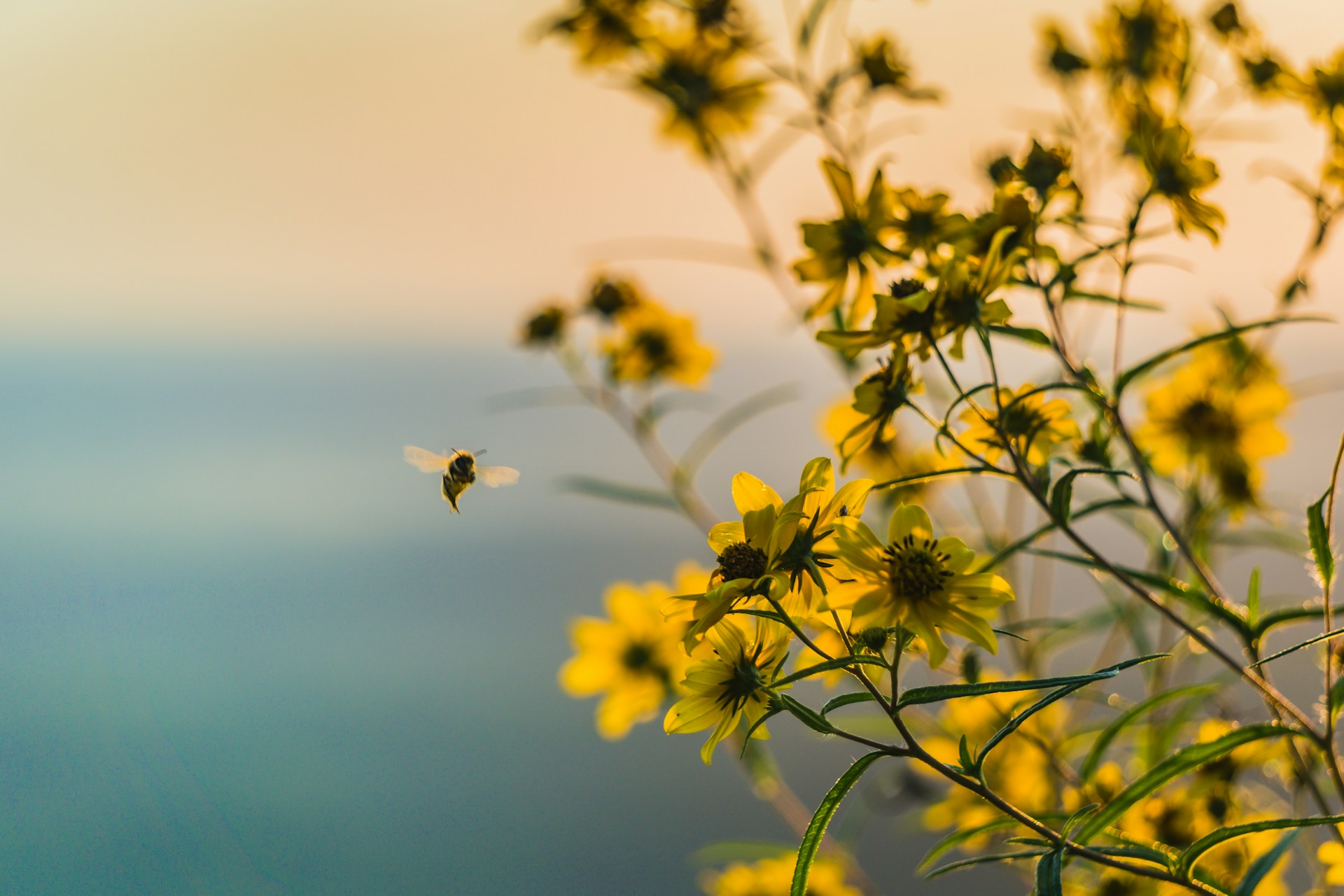
When I was doing research for the plants I wanted to incorporate into the text, rather than spend a lot of time interacting with primary sources authored by humans, I wanted to spend time with the plants as subjects, with the plants as informants, with the plants as co-authors. I did that by gardening with some of the plants that populate the book. Then I also spent a lot of time in environments where those plants grow. While I was working on the book, I would often take hikes into the Angeles National Forest where I would spend time with these plants in the hopes that they would reveal to me what role they wanted to have in the work. And I also hoped that some of the animals that I wanted to write about would reveal that as well. And for example, when I spent time in the forest, I had a lot of encounters with bees and beehives. And as a consequence of that, bees are very present in Poppy State. Bees are, I think, the first insects mentioned. I have a fascination with them because of their matriarchal society. I love that their society orbits entirely around a queen.
That is what a lot of my research looked like: patiently spending time with these living entities that I wanted to write about. But then I also spent a lot of time in digitized newspaper archives because I wanted to create a disorienting texture through time travel. A lot of Poppy State is set in my hometown, Santa Maria. I wanted the reader to understand Santa Maria as a town that grew through settler colonial establishment. I wanted for the reader to understand who these settlers were that populated this community, and what their relationship to the plant world was. I spent a lot of time communing with a particular set of ghosts who were Santa Maria’s early settlers. For example, Ida May Blochman and her husband Lazar Blochman feature really prominently. She was a school teacher who lived in the Santa Maria area, who was also a self-made botanist who wrote a column titled “Our Wildflowers.” I drew a lot from her column and spent a lot of time thinking about her as a result of that research.
Would you have days that were more about reading, absorbing, being with the plants, and then separate dedicated writing days, or are those practices fused for you?
Both. So there would be days that were spent more with plants, days when there was very little writing done with my hands, but the writing was being done with my eyes, with my nose, with my feet. So there might be a day where I hiked for five miles building story in my mind, and with these entities that I’m visiting in forests. Then there would be particular days where I would go down archival rabbit holes and spend hours on end just forgetting to eat or drink because I’m so fascinated by, for example, the wildflower column and wanting to catalog all the plants that this woman wrote about. Or I’d read all these excerpts from early twentieth-century botanical journals. So there were days that were more devoted to the page rather than to the forest.
I’m down to my last three questions, so I’ll shuffle my cards one last time. How do you decide when there should be negative space on the page?
The negative space on the page is so important to me. I love negative space. I also love silence, especially silence in the context of performance, because it is absolutely a provocation. I think that in the global north, we are supposed to fill time and space with so-called “content.” If we aren’t creating content and presenting it, then we’re expected to consume it. When we arrive at what one might call a blank page, there’s an invitation to be curious about nothing. What is the experience of staring into nothing? I think it makes people incredibly uncomfortable. It’s a provocation to stop and consider why that’s there. For every reader, that space is a projection screen onto which they project what they bring to the work. I can’t control what the reader brings to that space, but that emptiness is a site for the reader to make their own meaning. I think that that is really intimidating for a lot of readers, and I enjoy intimidating my readers.
I was listening to a book talk in which you said that your author’s note was meant to provoke the reader.
Exactly. I mean, on occasion, I do like to have my hand held, but that gets dull, and that gets boring. I used to be a teacher; in teacher training, we would learn about these different models and methods of pedagogy. There was this one Russian theorist who we would study, Vygotsky. He had this theory called the zone of proximal development, which is a really fancy way of describing this phenomenon that I think every effective teacher knows. Your job as a teacher–and I do think a lot of writers are essentially teachers because we teach information on the page–is to bring the student to a point of discomfort, without plunging that person into terror. You have to bring them into a state of mild to moderate discomfort, where they have the tools to get out of it. And I feel like what I try to do is bring the reader to a stage of much longer discomfort where they have the tools to exit it, but I can’t make you use the tools. There should be just enough discomfort that you feel slightly activated. But once the activation tips over into a paralysis, we have a problem. If you can’t move, then you can’t use the tools.
I have two questions left. I have a pink card and a blue card. Would you like to choose?
Yes. Let’s do the blue one.
You quote a botanist who says: “Renaming is a powerful form of colonialism. And then in the essay, “Lilies,” you write: “To become part of history, you have to write yourself into it.” Would you speak about the relationship between naming and renaming and writing oneself in this context of erasure?
Renaming can be generative, and renaming can be violent, and renaming can be fatal. As I mentioned earlier, I’m working on this book Fifteen Latinas. There’s a section in it where I narrate the arrival of Hernán Cortés on what has been renamed Veracruz. But the name that predates Veracruz is Totonacapan. There was a Totonac village that Cortés and his gang decamped in. And there were some Spanish explorers who thought that this village looked a lot like Andalucía. They said: “You know what? This village is not named what it’s named anymore. From this day forward, this is Sevilla.” Through that process, they’re killing a society through renaming. That same poisoning happened when Anglo settlers came to California. The same process happened with these Anglo pioneer women who were self-made botanists who went on botanizing excursions during the late nineteenth and twentieth century and “discovered California native plants” that they then applied their names to. But these California native plants had names that had been in existence for thousands of years. These were not discoveries. The act of imposing these names is so incredibly violent. I wanted to illustrate how this act that can seem very benign–taking away one word and replacing it with another word–can lead to disharmony in an ecosystem and in an environment. This disharmony is being caused by a human being.
Human beings are keystone species in every ecosystem in the world, and yet we’re often presented as if we’re subtracted from it. I was listening to an Indigenous scientist, Jessica Hernandez, talk about the water cycle. When kids are taught about the life cycle of water or the life cycle of a flower, who is subtracted from that cycle? The human. And yet the human is key. And so what we do, the behavior that we bring, even the linguistic behavior that we bring into environments, has the ability to heal, but it also has the ability to harm. I’m inviting people to really pay attention to what naming does, to reflect on practices of naming, and also to reflect on practices of recovering so-called lost languages or so-called extinct languages or so-called moribund languages, because there are so many languages that are dying as you and I speak, and linguistic diversity benefits us all. I would hope that by raising some awareness about languages, especially Indigenous languages facing extinction, some people can be activated to protect them.
This reminds me of how you say that something can be hidden in plain sound.
Exactly. If you don’t have the Indigenous framework through which to interpret the language, then you can’t hear it, you can’t perceive it. For example, Malibu is a Chumash word. But generally speaking, settlers are unaware that the world is awash in Indigenous names. I’m going to write about that as well when I talk about the first home where I lived with my parents. I write about how the street was named “Sway.” I thought as a child that it was named “Sway” because there were these really lovely sycamores, and this wind would blow through the valley where we lived, and the branches would sway. But then I came to learn that the valley where I live is a home to a lot of tarweed, and that a Chumash word for tarweed is “swey.” So my street was likely a derivation of that word, but I had no way of accessing that until I started looking at the language of the nation that stewards the land that raised me.
This is my last question. May I have a recent favorite plant anecdote?
Yes! So this is loosely a plant anecdote. Humans are more central to this story. But the other day, I was doing a Poppy State event at a bookstore in Monrovia. During these events I often try to coax people to tell me plant stories. But the other thing I do is try to coax people into sharing ghost stories because I love ghost stories. Everybody carries ghost stories. If you work hard enough to elicit them, you can get one out of anybody. There was a person in attendance who mentioned that he had worked in a warehouse, and the warehouse was haunted. He was saying that every warehouse where he has worked has supposedly been haunted. Oddly enough, usually the ghosts that haunt warehouses are children. I thought: “That’s awfully strange.” Maybe there are these child ghosts that aspire to drive forklifts. But what this person was saying was that the last haunted warehouse he worked at was an avocado warehouse. To me, that was such a romantic idea, a haunted avocado warehouse. Then I was like: but haunted by what? Humans or avocados? So that led to this whole haunted-avocado-warehouse fantasy.
This combination of images just made my mind bend.
There’s a lot happening there, right? Just so much. And it’s kind of delightful, too, because then we can bring guacamole into it.
And then what is guacamole in relation to ghosts?
There is so much there. And then there’s a connection with organized crime because the cartels now have cornered every market, including various agricultural markets. And so there have been these incredible narco-adjacent wars over avocados. And then that started to figure into my fantasy of this haunted avocado. There are infinite layers.
A full circle between susto and gusto, the aguacates, the haunting.
Exactly.
Poppy State is available for purchase here.
plants as subjects, plants as informants
In Conversation with Myriam Gurba
Part II
Billy Lezra
photo by Geoff Cordner
Myriam Gurba is a writer and activist. Her first book, the short story collection Dahlia Season, won the Edmund White Award for Debut Fiction. O, the Oprah Magazine ranked her true-crime memoir Mean as one of the “Best LGBTQ Books of All Time.” Her recent essay collection “Creep: Accusations and Confessions” was a finalist for a National Book Critics Circle award for Criticism, and won the Lambda Literary Award for Bisexual Nonfiction. She has written for the New York Times, Los Angeles Times, Harper’s Bazaar, Vox, and Paris Review. Her new book, “Poppy State: A Labyrinth of Plants and a Story of Beginnings,” was published by Timber Press in October 2025.
In Poppy State, California plants serve as structural anchors in a wildly inventive work of narrative nonfiction that is part botanical criticism, part personal storytelling, and part study of place. The reader is invited to commune with California with Gurba as their guide, ushered through a compendium of anecdotes, reminiscences, utterances, lists, incantations, newspaper articles, and other ephemera.
This interview has been edited for clarity and length.
My first question for you is from your author’s note: do you like surprises, or are you a person who prefers to consult a map prior to a quest?
Both. Sometimes I like to be surprised, but I have to be in a very stable place in my life in order to court surprises. And then, depending on the quest, sometimes I prefer a map. Sometimes I’m very adventurous, and other times, I’m not adventurous at all.
A map can be surprising, too.
A map can be surprising, and a map can be misleading. Sometimes you’re given a map, but the map doesn’t align with what it claims to represent.
The reason I wanted to start with that question is because I am hoping our interview will mirror the labyrinthian structure of Poppy State. I’ve prepared my questions and written them down on these pink and blue and yellow cards. Before every question I am going to shuffle the cards, so neither of us will know where we are going next. This is a contained surprise, so to speak.
This is fun for me. I do think that a maze and a labyrinth are containers. And they are containers that prompt surprise.
(Shuffles.)
There are so many titillating moments of wordplay in Poppy State: hoja, hoja, hojalá, ojalá. How do these moments come to you?
Those moments come to me through play. When I write, I’m playing. I’m having fun, and language becomes a toy. I let language show me the various faces that may have been hidden from me. So for example, if I’m going to write about horticulture or botany, I’m going to write about plants, and I’m doing so in a way that invites Spanglish thought. I’m going to think about leaf, and I’m going to think about hoja. And when I start repeating the word hoja, mentally, almost as a mantra, that’s going to invite related words. Sometimes the words are related botanically, but sometimes the words are simply related through sound, like ojalá. And so suddenly you get hoja, hoja, hojalá, ojalá. I find it delicious. It’s like eating candy. The language is a sugary toy. You’re getting these dopamine hits from the experience it’s giving.
This reminds me of the way you speak about texture of language. How do you know when an essay wants to be an essay in sentences? In particular, I’m thinking about “Lemmons” and “The Hill Monster.”
That is often intuitive. When writing about my father, I had very specific stories I wanted to share. Doing so was best achieved through a more traditional linear narrative, whereas when I’m writing about the more than human, and in particular, when I’m writing about plants or nonhuman animals, I approach that prose more like water; I let the water do what the water wants.
As I was reading–in particular, I’m thinking about “The Hill Monster”–each sentence seemed to flow into the next with a recurring image or motif. It felt very much like a stream.
I love that. I do consciously try to have these connective motifs that serve as binding agents and form these networks so that ideas that might seem disparate are connected to one another. A very careful reader can start to deconstruct those in the same way that a very careful naturalist might be able to start deconstructing a root network, and see how plants are generating through underground systems of rhizomes. So these two plants that might not seem to have a relationship to one another might actually be the same plant.
Connected through a thin root.
Exactly.
What are the most important elements of your creative ecosystem?
That’s a really amazing and surprising question. I really like thinking of creativity as belonging to an ecosystem. The first element that comes to mind for me is water. I engage in various spiritual practices that require daily practice. So there are daily behaviors that I engage in in my home at three different altars or three different shrines. And one of the most important aspects of caring for those shrines is ensuring that each one has a glass of water present to nourish the spirits that reside at those shrines, because the spirits are living entities, and all entities need water. Water is the source of life for everyone. And so water comes to mind. And then water is critical for me in the sense that when I first wake in the morning–and morning is my most productive and my most creative time–what I first need to do is drink coffee. And I can’t do that without boiling water. So without caffeine, which is a plant-based medicine activated by water, I’m nothing. I would say that half of my creativity is owed to that plant, and half of my personality is coffee-based.
(Laughs.)
I would also say that another element of that creative ecosystem is movement. I’m aware that I write with my entire body from head to toe. Writing isn’t something that’s confined to my hands. A lot of my writing, especially the part of my writing that is problem-solving, happens when I’m walking. Sometimes I go for as many as three or four walks in a day. I tend to walk between three and four miles, and during that process, I’m writing, solving problems. Then I’m able to come to the page and apply what I’ve learned through walking. That’s really critical. I would also say that visiting the plants that grow in my home garden is critical to my process. Because when I go and care for them and observe them, they always serve as mirrors that reflect me back at myself. They do that for me when it comes to all aspects of my life. If I bring myself as a writer to them, they reflect that back to me. In turn, they help enhance and deepen my creativity. For example, if I notice that a plant is experiencing a certain problem, and I have to help that plant overcome that problem, often there’s a lesson that I can apply to my own writing that the plant is imparting to me.
Would you give me an example of a lesson a plant has imparted?
This morning, I went to check on some of the plants I have growing in the vegetable garden in my front yard. I have a pepper bush, poblanos. There was one pepper that was very ready to be harvested. But the others were still in the process of ripening. I picked that one, brought it inside, and added it to a small bowl with other peppers. I now have four peppers that are ripe and ready to be turned into something edible. Those four peppers remind me that I have a set of essays that I haven’t touched in a few months, but they’re ready to be touched now. They’ve been sitting and ripening, and now they’re ready for me to return to them. So there will be these uncanny parallels that the plants will provoke and that will then set me on a path toward some creative act. But the plants have a hand in that.
Who is a tree you currently have a crush on?
I love that question. My heart very much belongs to oaks. I’ve never really been able to move past the girlish crush that I developed on oak trees. This morning I was going for a walk, and I was so happy because it’s been raining cats and dogs here in Southern California. And the land smelled so delicious. Rain gave us this wet potpourri, so I was just ravenously inhaling the aroma from the earth. And I typically walk on one particular side of a street, but I decided to switch it up and walk on this other side, and from this other side, I noticed this oak tree that I had not noticed before. I was like, “That oak looks good!” I was like, “I’ve never seen her from this angle. Oh, my goodness, look at the way that she’s arching her back and throwing out her arms, and her hair looks good.” She knows she’s fabulous. I’m so happy I’ll get to go back and check her out from another angle.
And you hadn’t seen her before!
No, I hadn’t noticed her before. She’s been there, but because of the way that I would walk, I could only see up to her shins because she’s so tall. But now that I saw her from a distance, I got to see her whole body.
Would you speak about the relationship between the fog in Creep and the maze and labyrinth in Poppy State?
I’m so glad that you saw that connection. As I was working on Poppy State, I was very aware that I had relied on this climatological metaphor to indicate soft lethality. Fog is a place where a victim can become lost and missing and never recovered. And so Poppy State for me is a way of exiting that fog. It provides a bridge for exiting it, but that bridge is still fraught because one has to travel through a structure that can be quite confusing. So in a way, there is an extension of that fog, but there’s the suggestion of an exit from it. The other function that’s being performed by both the labyrinth and the fog is that they serve as containers for these monstrous figures that dwell in both. In the case of the fog in Creep, there’s a monstrous figure who’s represented through this figure who I named “Q.” Whereas in Poppy State, the monstrous figures and the perpetrators take on more fabulist qualities. There is also a nod toward Greek mythology because we have a structure that is a labyrinth. We’ve got these various monstrous figures, like the marijuana prince, who inhabits this labyrinth that I’ve created, and they’re contained therein in the same way that the minotaur is contained therein. It is possible to enter the labyrinth and exit. But some people who enter that labyrinth don’t come out.
But the possibility of emergence exists.
Absolutely. The other thing, too, is that I refer to the structure as both labyrinth and maze. While a labyrinth is more simple in the sense that you have one entrance and one exit, a maze has more points of entry and exit. I think that Poppy State is the type of work that you can dip in and out of as needed or as wanted. It’s likely that when readers first engage with it, they might engage with it in a much more traditional and linear fashion, reading it from start to finish. But I also hope that readers are able to dip in and out as they wish and don’t feel constrained by linear reading. Because I certainly don’t feel constrained by having to read things in a linear way. I actually enjoy reading things backwards, or on occasion, I’ll start in the middle. I would love to encounter a reader who starts Poppy State in the middle, or who opens it to a random page, or a reader who uses it for bibliomancy, as a divinatory tool.
As soon as I finished it, I wanted to read it backwards. I wanted to know what the labyrinth would feel like from the opposite direction.
I love that because you’re retracing your own footsteps, so to speak. And that’s how you learn a labyrinth: by entering it and then moving through it backwards. And so I love that you’re trying to feel your way through what you’ve traveled, through repetition.
Yes. I notice how you’re talking about these multiple points of entry within the maze, which seems distinct from fog. When you’re in the fog, you can’t see your own hand. Where is the entry? Where is the exit? Did we even enter?
Exactly. Whereas if you have a maze with these multiple points of entry, that implies that you have multiple points of light, so to speak. Because if you’ve got an entrance or an exit, then you’ve got the suggestion of light to move toward. And so you’ve got light penetrating, not just in one or two places, but all around. Your possibility of entry is heightened; your possibility of escape is heightened.
In Poppy State, you write about the humongous fungus that occupies this vast acreage in Oregon. What is something that is currently taking up vast acreage in your intellectual ecosystem?
Right now, I’m completing a manuscript called Fifteen Latinas. And it is, in some ways, the quinceañera that I never had. But rather than enjoy this celebration with flesh and blood figures, I’m throwing myself a literary quinceañera with Latinas across time and space who I’ve invited to convene with me on the page. And so this is occupying my mind at the moment: all these figures who I’m trying to bring together between the covers of a book. And through these figures and with these figures, I’m attempting to deconstruct Latin American history and Latinidad, and understand Latinidad as a settler colonial construction. And I’m trying to locate women’s place within that construction, and women’s roles in the transformation of that settler colonial phenomenon. One figure whom I have written about is a Haitian Vodou priestess named Cécile Fatiman. Another figure whom I have written about is Zora Neale Hurston because of the vast amount of anthropological work she did into Afro-Caribbean spiritual traditions. The Caribbean is the birthplace of Latin America, and so often the Caribbean is overlooked when we talk about Latinas. My goal is to center the Caribbean.
I have also been writing about Latinas who I’ve had very close, spiritually intimate relationships with, like the late Tatiana de la Tierra, who was from Colombia. There’s an entire section devoted to my friendship with her and the queer mentorship that she provided me with. I’m also writing about the Baroque new Spanish nun, Sor Juana Inés de la Cruz. I’m writing about how her genius is so frequently fetishized as a rarity, but there are so many geniuses who were her contemporaries who weren’t seen as such because of racialization. The word “genius” is not applied to Malinalli, Malintzin, Malinche. She’s often described as a brilliant interpreter: she was a fucking genius. So why are we not using the word “genius” applied to this fifteen year-old who essentially was the conquistador? Who gets to be a genius then, according to these Western ways of thinking? So this is who has been occupying my imagination. Now I’m having the quinceañera I never had, but I’m having it on my terms, raising the dead because I want Sor Juana there.
You write that Poppy State is an account of spiritual sickness, of susto. And you write: “I had to give myself a reason to stop wandering.” Would you speak about the relationship between the writing process and restoring oneself in the aftermath of susto?
Yes. So to begin, and for those who may come to this interview without an understanding of susto, I’ll give a really brief explanation of what that spiritual sickness entails. Throughout Latin America, there are many communities that identify a spiritual sickness by the name of susto, which loosely translates in English to the word “fear.” While the manifestations can differ slightly in subtle ways, essentially, what they all have in common is that a person experiences what we might call, in a Western context, trauma. A person has some brush with death, a brush with mortality. That brush with death or brush with mortality initiates the process of stopping the life force from that individual. It can initiate what is called soul loss, which in extreme cases can be fatal. Different societies have developed different treatments for soul loss. A lot of those treatments are botanically-based. Very often, they involve the collection of medicinal and sacred plants, and then a person’s interaction with those plants. Often, those interactions are mediated by some spiritual doctor, spiritual technician, like a curandera. In addition to healing the individual, there also is often a healing of the place where the offense occurred. Not only has the individual been wounded, the place has also experienced a wound.
And so for harmony to be restored, the individual and their relationship to the place both have to be returned to harmony. And in my case, there wasn’t necessarily a person who intervened as a spiritual technician to help re-establish that harmony. I was able to intuitively use different practices to restore my sense of balance and to make it so that my soul returned to me and stopped wandering so much. Rather than the writing itself playing a role in the restoration of that balance, or that harmony, or that homeostasis, in my case, the writing served to document it rather than orchestrate it. Because I have a compulsion to write, the writing takes place in order to document how I perform what we might call this magical intervention.
This reminds me of how, in our last conversation, you said that there can be an idea that the act of writing is cathartic, but that for you, catharsis exists outside of writing, when you’re walking among the trees. The writing describes it but is not it.
Exactly. And in that sense, I think that writing has a lot in common with magic, not magic in the sense of spiritual magic, but magic in the sense of trickery, that you have a slight of hand. The writer is acting as a magician. They’re creating a facsimile on the page. And the reader is experiencing a trick, an illusion of catharsis. And so you get to metabolize what appears to be healing but is actually only a reflection of it. If you want that healing, you’ll have to find a way to do it yourself.
What you are saying is making me think of how, as I was preparing these questions, I kept miswriting “susto” as “gusto.” It happened at least three times. It was such a funny slippage. But then I started thinking about gusto in relation to the gusto of the plant, the gusto of being with the oak tree. The gusto is in the restoration, not in the documentation.
Exactly. And if you consider gusto, and here I’ll transition to English: gustatory, right? When we go and have these gustatory experiences, in addition to being filled with pleasure, these experiences are often experiences of satiety. And when we experience fear, we can’t access satiety. And so to me, gusto is the flip side of susto.
Would you walk me through what your research process looks and feels like?
When I was doing research for the plants I wanted to incorporate into the text, rather than spend a lot of time interacting with primary sources authored by humans, I wanted to spend time with the plants as subjects, with the plants as informants, with the plants as co-authors. I did that by gardening with some of the plants that populate the book. Then I also spent a lot of time in environments where those plants grow. While I was working on the book, I would often take hikes into the Angeles National Forest where I would spend time with these plants in the hopes that they would reveal to me what role they wanted to have in the work. And I also hoped that some of the animals that I wanted to write about would reveal that as well. And for example, when I spent time in the forest, I had a lot of encounters with bees and beehives. And as a consequence of that, bees are very present in Poppy State. Bees are, I think, the first insects mentioned. I have a fascination with them because of their matriarchal society. I love that their society orbits entirely around a queen.
That is what a lot of my research looked like: patiently spending time with these living entities that I wanted to write about. But then I also spent a lot of time in digitized newspaper archives because I wanted to create a disorienting texture through time travel. A lot of Poppy State is set in my hometown, Santa Maria. I wanted the reader to understand Santa Maria as a town that grew through settler colonial establishment. I wanted for the reader to understand who these settlers were that populated this community, and what their relationship to the plant world was. I spent a lot of time communing with a particular set of ghosts who were Santa Maria’s early settlers. For example, Ida May Blochman and her husband Lazar Blochman feature really prominently. She was a school teacher who lived in the Santa Maria area, who was also a self-made botanist who wrote a column titled “Our Wildflowers.” I drew a lot from her column and spent a lot of time thinking about her as a result of that research.
Would you have days that were more about reading, absorbing, being with the plants, and then separate dedicated writing days, or are those practices fused for you?
Both. So there would be days that were spent more with plants, days when there was very little writing done with my hands, but the writing was being done with my eyes, with my nose, with my feet. So there might be a day where I hiked for five miles building story in my mind, and with these entities that I’m visiting in forests. Then there would be particular days where I would go down archival rabbit holes and spend hours on end just forgetting to eat or drink because I’m so fascinated by, for example, the wildflower column and wanting to catalog all the plants that this woman wrote about. Or I’d read all these excerpts from early twentieth-century botanical journals. So there were days that were more devoted to the page rather than to the forest.
I’m down to my last three questions, so I’ll shuffle my cards one last time. How do you decide when there should be negative space on the page?
The negative space on the page is so important to me. I love negative space. I also love silence, especially silence in the context of performance, because it is absolutely a provocation. I think that in the global north, we are supposed to fill time and space with so-called “content.” If we aren’t creating content and presenting it, then we’re expected to consume it. When we arrive at what one might call a blank page, there’s an invitation to be curious about nothing. What is the experience of staring into nothing? I think it makes people incredibly uncomfortable. It’s a provocation to stop and consider why that’s there. For every reader, that space is a projection screen onto which they project what they bring to the work. I can’t control what the reader brings to that space, but that emptiness is a site for the reader to make their own meaning. I think that that is really intimidating for a lot of readers, and I enjoy intimidating my readers.
I was listening to a book talk in which you said that your author’s note was meant to provoke the reader.
Exactly. I mean, on occasion, I do like to have my hand held, but that gets dull, and that gets boring. I used to be a teacher; in teacher training, we would learn about these different models and methods of pedagogy. There was this one Russian theorist who we would study, Vygotsky. He had this theory called the zone of proximal development, which is a really fancy way of describing this phenomenon that I think every effective teacher knows. Your job as a teacher–and I do think a lot of writers are essentially teachers because we teach information on the page–is to bring the student to a point of discomfort, without plunging that person into terror. You have to bring them into a state of mild to moderate discomfort, where they have the tools to get out of it. And I feel like what I try to do is bring the reader to a stage of much longer discomfort where they have the tools to exit it, but I can’t make you use the tools. There should be just enough discomfort that you feel slightly activated. But once the activation tips over into a paralysis, we have a problem. If you can’t move, then you can’t use the tools.
I have two questions left. I have a pink card and a blue card. Would you like to choose?
Yes. Let’s do the blue one.
You quote a botanist who says: “Renaming is a powerful form of colonialism. And then in the essay, “Lilies,” you write: “To become part of history, you have to write yourself into it.” Would you speak about the relationship between naming and renaming and writing oneself in this context of erasure?
Renaming can be generative, and renaming can be violent, and renaming can be fatal. As I mentioned earlier, I’m working on this book Fifteen Latinas. There’s a section in it where I narrate the arrival of Hernán Cortés on what has been renamed Veracruz. But the name that predates Veracruz is Totonacapan. There was a Totonac village that Cortés and his gang decamped in. And there were some Spanish explorers who thought that this village looked a lot like Andalucía. They said: “You know what? This village is not named what it’s named anymore. From this day forward, this is Sevilla.” Through that process, they’re killing a society through renaming. That same poisoning happened when Anglo settlers came to California. The same process happened with these Anglo pioneer women who were self-made botanists who went on botanizing excursions during the late nineteenth and twentieth century and “discovered California native plants” that they then applied their names to. But these California native plants had names that had been in existence for thousands of years. These were not discoveries. The act of imposing these names is so incredibly violent. I wanted to illustrate how this act that can seem very benign–taking away one word and replacing it with another word–can lead to disharmony in an ecosystem and in an environment. This disharmony is being caused by a human being.
Human beings are keystone species in every ecosystem in the world, and yet we’re often presented as if we’re subtracted from it. I was listening to an Indigenous scientist, Jessica Hernandez, talk about the water cycle. When kids are taught about the life cycle of water or the life cycle of a flower, who is subtracted from that cycle? The human. And yet the human is key. And so what we do, the behavior that we bring, even the linguistic behavior that we bring into environments, has the ability to heal, but it also has the ability to harm. I’m inviting people to really pay attention to what naming does, to reflect on practices of naming, and also to reflect on practices of recovering so-called lost languages or so-called extinct languages or so-called moribund languages, because there are so many languages that are dying as you and I speak, and linguistic diversity benefits us all. I would hope that by raising some awareness about languages, especially Indigenous languages facing extinction, some people can be activated to protect them.
This reminds me of how you say that something can be hidden in plain sound.
Exactly. If you don’t have the Indigenous framework through which to interpret the language, then you can’t hear it, you can’t perceive it. For example, Malibu is a Chumash word. But generally speaking, settlers are unaware that the world is awash in Indigenous names. I’m going to write about that as well when I talk about the first home where I lived with my parents. I write about how the street was named “Sway.” I thought as a child that it was named “Sway” because there were these really lovely sycamores, and this wind would blow through the valley where we lived, and the branches would sway. But then I came to learn that the valley where I live is a home to a lot of tarweed, and that a Chumash word for tarweed is “swey.” So my street was likely a derivation of that word, but I had no way of accessing that until I started looking at the language of the nation that stewards the land that raised me.
This is my last question. May I have a recent favorite plant anecdote?
Yes! So this is loosely a plant anecdote. Humans are more central to this story. But the other day, I was doing a Poppy State event at a bookstore in Monrovia. During these events I often try to coax people to tell me plant stories. But the other thing I do is try to coax people into sharing ghost stories because I love ghost stories. Everybody carries ghost stories. If you work hard enough to elicit them, you can get one out of anybody. There was a person in attendance who mentioned that he had worked in a warehouse, and the warehouse was haunted. He was saying that every warehouse where he has worked has supposedly been haunted. Oddly enough, usually the ghosts that haunt warehouses are children. I thought: “That’s awfully strange.” Maybe there are these child ghosts that aspire to drive forklifts. But what this person was saying was that the last haunted warehouse he worked at was an avocado warehouse. To me, that was such a romantic idea, a haunted avocado warehouse. Then I was like: but haunted by what? Humans or avocados? So that led to this whole haunted-avocado-warehouse fantasy.
This combination of images just made my mind bend.
There’s a lot happening there, right? Just so much. And it’s kind of delightful, too, because then we can bring guacamole into it.
And then what is guacamole in relation to ghosts?
There is so much there. And then there’s a connection with organized crime because the cartels now have cornered every market, including various agricultural markets. And so there have been these incredible narco-adjacent wars over avocados. And then that started to figure into my fantasy of this haunted avocado. There are infinite layers.
A full circle between susto and gusto, the aguacates, the haunting.
Exactly.